Quick answer
Compare inverters at the same capacity and phase, then check the battery voltage range, number of MPP trackers, protection rating and warranty; our brand-vs-brand tables list the models and prices side by side.
On this page: Start with your own needs, not the brand · The three brands in plain words · How to compare deye vs growatt vs huawei inverters: the seven checks · Side-by-side overview of the three brands · Which brand fits which situation · Two worked calculations for comparing deye vs growatt vs huawei inverters · Batteries, monitoring and after-sales support · Common mistakes to avoid · Frequently asked questions · Choosing between Deye vs Growatt vs Huawei inverters
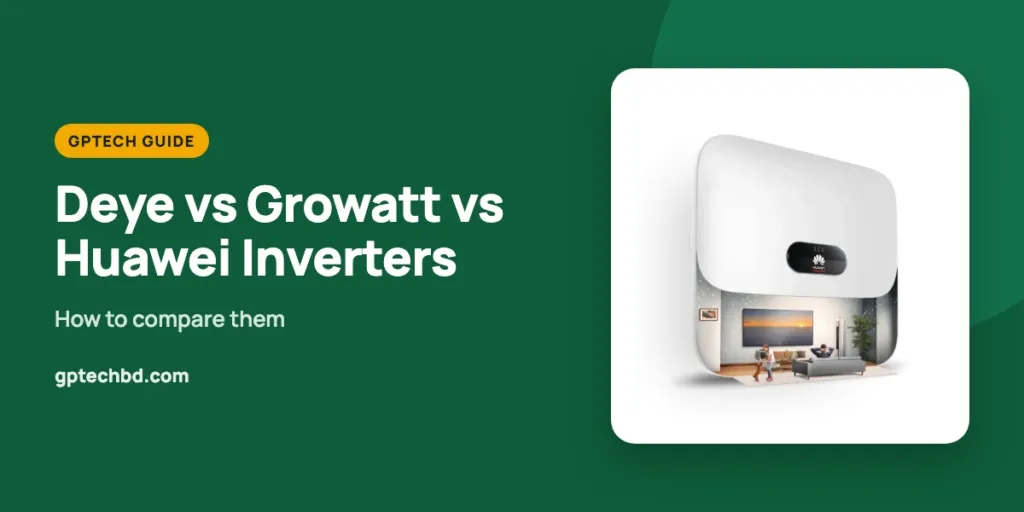
There is no single winner in Deye vs Growatt vs Huawei inverters, because each brand is strongest in a different situation: Deye is widely chosen for hybrid systems that need flexible battery choices, Growatt covers on-grid, hybrid and off-grid with one familiar app, and Huawei suits owners who want a tightly integrated string-inverter and battery package. The right pick depends on your load, your battery plans, your roof and, just as importantly, who will service it.
This article shows you how to compare deye vs growatt vs huawei inverters yourself, using a short checklist, a scoring method and two worked calculations. We stay with well-known, general facts and send you to the datasheets and the warranty page for exact numbers, since specifications change from model to model and year to year.
Start with your own needs, not the brand
Most people open the deye vs growatt vs huawei inverters question by asking which brand is best. A better first question is what the inverter has to do for you. Write down answers to these five questions before you look at any catalogue:
- Do I need power during load-shedding, or only want to cut my bill?
- Will I add a battery now, or maybe in two years?
- Is my building single-phase or three-phase?
- How much clear roof do I have, and is any of it shaded?
- Who will I call when something goes wrong?
If your answer to the first question is “only cut my bill”, an on-grid inverter does the job and a battery is not needed. If you want backup power, you are shopping for a hybrid inverter. Our guide to single-phase hybrid inverters is a good place to browse once you know that.
A few terms to know. An on-grid (grid-tied) inverter feeds the building and the grid, and stops in a blackout. A hybrid inverter also manages a battery and can run selected loads when the grid fails. A string inverter takes several panels wired in a row (a string) into one box. MPPT means maximum power point tracking, the circuit that squeezes the most power from the panels as sun and temperature change. The Wikipedia article on solar inverters explains these types in a little more depth.
The three brands in plain words
What follows is a fair, general picture of deye vs growatt vs huawei inverters. It does not rank the brands, and it avoids efficiency percentages or failure rates, because those depend on the exact model and you should read them from the datasheet.
Deye
Deye is best known in this region for hybrid inverters. The range includes both low-voltage models that work with 48V batteries and high-voltage models for stacked high-voltage battery systems. Many Deye hybrids are valued for accepting a wide variety of lithium batteries that can talk to the inverter, so you are less tied to one battery maker. Some models offer parallel connection, which lets you add a second inverter later as the load grows. Monitoring on many models is through a Solarman-based app and data logger. Confirm the details of the exact model.
Growatt
Growatt offers on-grid, hybrid and off-grid ranges, so one brand can cover a home hybrid, a shop’s on-grid system and a remote site. Monitoring uses the ShinePhone app for owners and the ShineServer web platform, which many installers are used to. Growatt also has its own battery lines in some ranges and supports others on certain hybrids, so check the compatibility list for your inverter model.
Huawei
Huawei inverters in the SUN2000 family are string inverters with a reputation for neat engineering and a strong monitoring platform in the FusionSolar app. Hybrid-capable SUN2000 models are designed to work with Huawei’s own LUNA2000 battery, which means a very integrated system, but also that you generally choose from Huawei’s battery family rather than from many third-party batteries. Huawei also offers optional panel-level optimisers on some designs, useful on shaded roofs.
How to compare deye vs growatt vs huawei inverters: the seven checks
Use these seven checks, in order, for any shortlisted model.
1. Type and phase
Match the inverter to the building: single-phase for most homes, three-phase for factories, large shops and bigger buildings. For a three-phase connection you can browse the three-phase on-grid range. A single-phase inverter on a three-phase supply needs careful design.
2. Size against the panels
Compare the panel array (in kWp) to the inverter rating. A modest oversize on the DC side is common and fine. We do a worked check below.
3. Voltage window and MPPT inputs
Every inverter has a maximum DC input voltage and a working range. If your roof has two sections facing different directions, you want at least two MPPT inputs so each side tracks separately.
4. Battery compatibility
This matters only for hybrids. Ask for the written list of batteries approved for the exact inverter model, the battery voltage class and whether the link is by communication cable.
5. Backup behaviour
Check the backup output rating, how fast it switches over during an outage, and whether it can start your pump or compressor loads. The headline kW figure and the surge figure are often different.
6. Monitoring
Look at the app: is it easy to read, does it show generation, consumption and battery state, and does it need a Wi-Fi dongle that your router can reach? Remote visibility reduces service visits.
7. Warranty and service path
Read the warranty terms, not just the number of years. Who replaces a failed unit, how long does it take, and is on-site support available in your district? Our article on what a solar inverter warranty covers and does not cover goes through the usual exclusions.
Side-by-side overview of the three brands
This table is a general guide to how the three brands are commonly positioned. Details differ by model, so treat any cell as a prompt to check the datasheet.
| Point | Deye | Growatt | Huawei |
|---|---|---|---|
| Best-known strength | Hybrid inverters with flexible battery options | Wide range: on-grid, hybrid and off-grid | Integrated string inverter and battery system |
| Typical use | Homes and shops wanting load-shedding backup | Mixed use, from small homes to commercial sites | Homes and commercial roofs that value neat integration |
| Battery approach | Works with many communicating lithium batteries | Own batteries plus listed third-party options on some models | Pairs with Huawei LUNA2000 |
| Monitoring | Solarman-based app on many models | ShinePhone app and ShineServer | FusionSolar app |
| Three-phase options | Available, check models | Available, check models | Strong three-phase string range |
| Check before buying | Battery approval list, parallel rules | Exact model and battery list | Battery plan and accessories included |
For side-by-side price pages built on current stock, see our Deye vs Growatt, Deye vs Huawei and Growatt vs Huawei pages, or use the compare tool to put chosen models next to each other.
Which brand fits which situation
With the checks in hand, here is how deye vs growatt vs huawei inverters usually line up against real Bangladeshi situations. They are tendencies, not rules.
- Flat or home with 2 to 4 hours of load-shedding and a wish to add batteries over time: a hybrid with broad battery support is attractive. Deye is a frequent choice here.
- Shop wanting lower bills and no battery: a simple on-grid string inverter from any of the three is enough. Choose the one with the best local support.
- Mixed site with a pump house, a shop and a small guest room: Growatt’s range can cover different parts with one app family.
- Factory or large commercial roof, three-phase, bill reduction first: a three-phase string inverter, where Huawei and Growatt are both common. Read our factory rooftop guide if this is you.
- Home that wants a neat, single-vendor solar plus battery package: Huawei’s inverter and LUNA2000 pairing is the logic of that approach.
- Remote site with no reliable grid: an off-grid or hybrid with generator input, where Growatt or Deye ranges are worth reviewing.
Two worked calculations for comparing deye vs growatt vs huawei inverters
A. Does the array fit the inverter?
Suppose you plan 12 panels of 550W and a 5kW inverter.
- Array size: 12 x 550W = 6,600W, which is 6.6kWp.
- DC-to-AC ratio: 6.6 / 5 = 1.32.
- Check the datasheet: it lists the maximum DC input power or recommended ratio. If the limit is higher than 6.6kWp, you are fine on power.
Now check voltage with illustrative numbers. Assume each panel’s open-circuit voltage (Voc, the voltage with no load) is about 50V, and add roughly 5 percent for a cold morning: 50 x 1.05 = 52.5V.
- 12 panels in one string: 12 x 52.5 = 630V.
- If the datasheet says the maximum DC voltage is 550V, 630V is too high and could damage the inverter.
- Two strings of 6: 6 x 52.5 = 315V each, which is safely under the limit. This needs two MPPT inputs.
The 50V and 550V figures are examples. Use your panel’s Voc and your inverter’s maximum from their datasheets.
B. A scoring sheet for three shortlisted models
Give each need a weight that adds up to 100, then score each inverter from 1 to 5 using the datasheets and what your supplier tells you. Here is an illustrative buyer who cares most about batteries and service. Inverters X, Y and Z are placeholders for whichever three models you shortlist, not claims about any brand.
| Criterion | Weight | Inverter X | Inverter Y | Inverter Z |
|---|---|---|---|---|
| Battery flexibility | 30 | 5 | 3 | 2 |
| Monitoring app | 15 | 4 | 4 | 5 |
| Local service and warranty | 25 | 3 | 4 | 4 |
| Fits the roof and phase | 20 | 4 | 4 | 3 |
| Price on the quotation | 10 | 3 | 4 | 3 |
The sums: X = (30×5) + (15×4) + (25×3) + (20×4) + (10×3) = 150 + 60 + 75 + 80 + 30 = 395, so 3.95 out of 5. Y = 90 + 60 + 100 + 80 + 40 = 370, so 3.70. Z = 60 + 75 + 100 + 60 + 30 = 325, so 3.25. For this buyer, X wins mainly because battery flexibility carries the biggest weight. A different buyer, perhaps a factory without a battery, would weight things differently and may choose another model.
Batteries, monitoring and after-sales support
Batteries
For a hybrid system the battery choice is half of the decision. Deye is often selected where buyers want to choose among several communicating lithium batteries, Huawei where they accept the matched LUNA2000 route, and Growatt where its own batteries or an approved list suit them. To understand the battery side, read our comparison of lithium LiFePO4 vs lead-acid batteries and the guide to sizing a battery for your backup hours.
Monitoring in daily life
The best monitoring app in a deye vs growatt vs huawei inverters comparison is the one you actually open. Check that the app shows production, consumption and battery state in a form you understand, that it keeps working when your Wi-Fi drops, and that your installer can see alerts remotely. Poor router coverage on a roof or in a plant room is a common cause of “offline” inverters, so mention it at the site survey.
Installation quality counts as much as the brand
Whatever the outcome of deye vs growatt vs huawei inverters on paper, a well-chosen inverter can still disappoint if it is fitted in direct afternoon sun, in a damp stairwell or on a wall with loose fixings. Inverters shed heat, and many reduce their output when they get too hot, which is a real concern on a Bangladeshi rooftop in April. Choose a shaded, ventilated, dry wall, leave the clearances the manual asks for, and use correctly sized cables with proper earthing. Our installation and site survey notes cover what a technician checks on the day.
Support and warranty
In practice, service quality decides whether you are happy in year four. Ask who inspects a fault, whether a replacement unit is held locally, and what proof of installation is required. Look at the GPTECH warranty page and the manufacturer’s datasheet for years and conditions; do not rely on a verbal promise. A great product with no one nearby to support it is a worse buy than a good product with a responsive local team.
Common mistakes to avoid
- Choosing the brand first and the system second. In any deye vs growatt vs huawei inverters shortlist, the system design should come first. Define the loads, phase and backup need before you shop.
- Reading kW as a promise of backup. A hybrid’s grid-tied rating and its backup output can differ. Check both.
- Not checking the battery approval list. Buying a cheap battery that the inverter cannot talk to causes limited charging or errors.
- Ignoring string voltage. An over-long string on a cold morning can exceed the inverter’s limit, as the example above shows.
- Skipping the single-phase or three-phase question. It affects both the inverter and the wiring.
- Trusting spec sheets from unofficial sources. Use the manufacturer datasheet for the exact model.
- Comparing prices of different scopes. One quote includes battery and breakers, the other does not.
- Underestimating future loads. If you plan another AC, think about parallel capability or a larger unit.
- Forgetting the Wi-Fi at the inverter location. No signal, no remote monitoring.
Frequently asked questions
Which is better in deye vs growatt vs huawei inverters?
In a deye vs growatt vs huawei inverters choice, none is best for everyone. Deye is popular for flexible hybrid setups, Growatt for its broad range, and Huawei for integrated string-inverter and battery systems. Choose by use case, battery plans and service availability.
Is Huawei inverter better than Growatt?
It depends on what you need. Huawei is often chosen for neat integration with its own battery and app, while Growatt offers more variety across on-grid, hybrid and off-grid. Compare the exact models using their datasheets.
Which inverter is best for load-shedding in Bangladesh?
Any hybrid inverter paired with a suitable lithium battery can ride through load-shedding. Look at backup rating, switchover time and battery compatibility rather than brand alone. Our article on IPS versus solar hybrid for load-shedding helps with this choice.
Can I use any lithium battery with a Deye inverter?
No. Choose a battery that is on the approved list for your exact Deye model and has a communication link where required. Ask the supplier for written confirmation.
Does Huawei work with other brands of battery?
Huawei hybrid systems are designed around its LUNA2000 batteries, so third-party batteries are generally not the intended route. Confirm the current position for your model with the supplier.
What does the monitoring app do?
It shows how much your panels produce, how much you use and, on hybrids, the battery level. Growatt uses ShinePhone, Huawei uses FusionSolar, and many Deye units use a Solarman-based app.
How long is the warranty on these inverters?
It varies by model and brand, so read the datasheet and the warranty page rather than trusting a number from memory. Also ask what is excluded, such as damage from poor earthing, water or voltage surges.
Should I choose by price?
Price matters, but compare the full scope of each quotation, including battery, protection and service. A slightly dearer inverter with solid support often costs less over its life.
Choosing between Deye vs Growatt vs Huawei inverters
To settle deye vs growatt vs huawei inverters, run your own seven checks, score the shortlisted models with weights that match your priorities, and give extra weight to battery compatibility and local service. Then ask for the datasheets and the warranty terms in writing.
If the deye vs growatt vs huawei inverters decision still feels close, you can call GPTECH on +880 1712-567878 or message us on WhatsApp for a free site survey and quotation. We stock Deye, Growatt, Huawei and SolaX inverters, supply genuine, warranty-backed products, and deliver across Bangladesh, so we can show you real options side by side without pushing one brand.
Frequently asked questions
Which brand is best?
There is no single best brand. Match the inverter type, phase, capacity and battery voltage to your system, then compare warranty and price at the same capacity.
What should I compare first?
Capacity and phase, then the inverter type (on-grid, hybrid or off-grid), then battery voltage range if you need backup.
Where can I see models and prices side by side?
Our comparison pages list Deye, Growatt and Huawei models at matching capacities with current prices.
Do all three support batteries?
Hybrid models do; on-grid models do not use batteries. Check each product's specification table for the battery voltage range.
Related products
-
SolaX
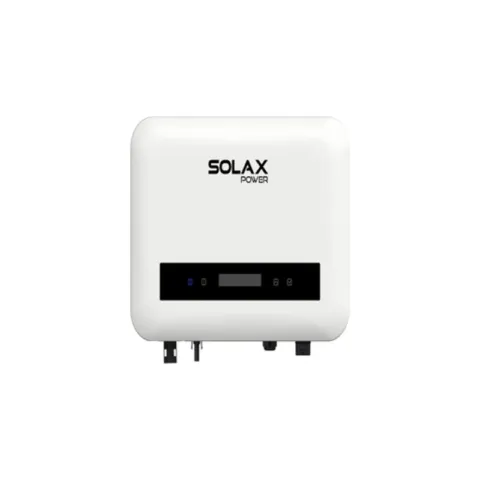
SolaX 5kW Single Phase On-Grid Solar Inverter (X1-MINI-5K-G4-P)
৳33,000 In stock -
SolaX
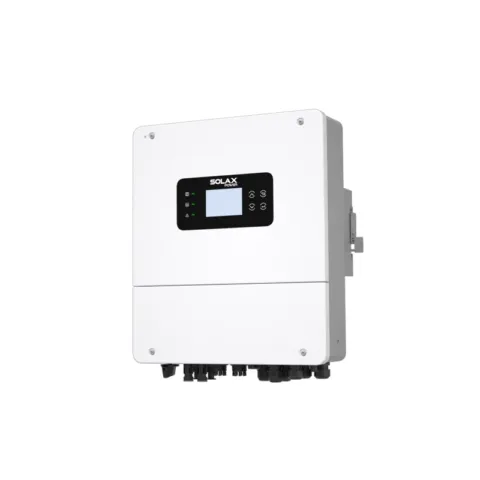
SolaX 3kW Single Phase Low Voltage Hybrid Solar Inverter
৳100,100 In stock -
SolaX
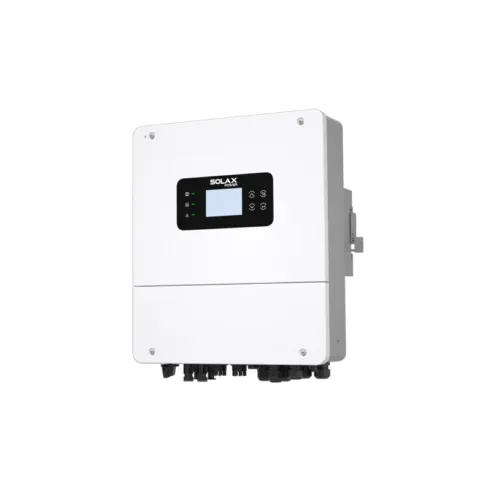
SolaX 5kW Single Phase Low Voltage Hybrid Solar Inverter (SREDA approved)
৳121,000 In stock -
SolaX
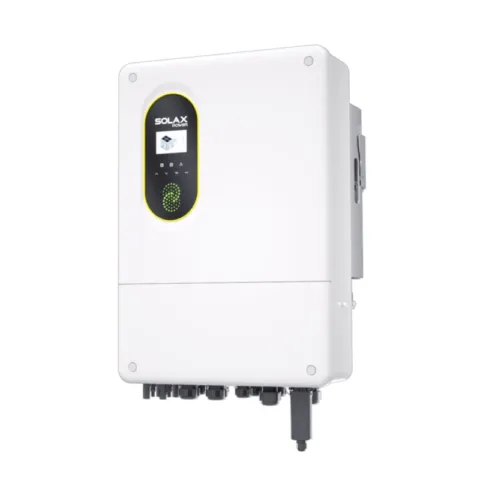
SolaX 10kW Three Phase Low Voltage Hybrid Solar Inverter
৳242,000 In stock