সংক্ষেপে উত্তর
A pure sine wave IPS in Bangladesh costs from about ৳9,000 for 600VA to about ৳45,000 for 5kVA, before the battery. Size it by adding up the watts you need during load-shedding and dividing by 0.7.
On this page: IPS price list · What an IPS is · What size IPS you need · Choosing the battery · Backup time · Total cost · IPS or solar hybrid? · Buying checklist · Mistakes to avoid · Care and safety · FAQ
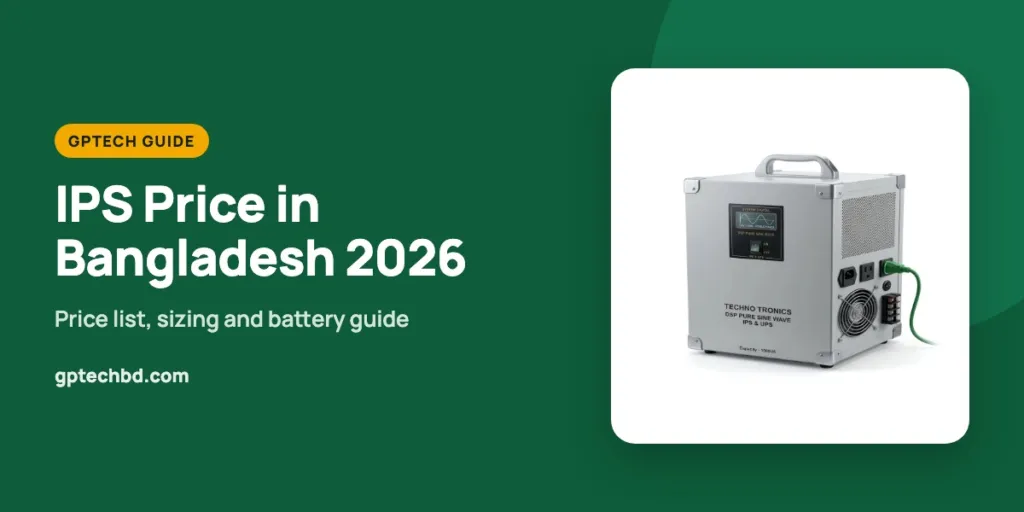
The IPS price in Bangladesh starts at about ৳৯,৯০০ for a 600VA pure sine wave unit and goes up to around ৳৪৯,৫০০ for a 5kVA model, before you add the battery. That is the short answer. The longer answer matters more, because the IPS box is only half of the cost and the wrong size is the most common reason people come back unhappy.
We sell, install and repair backup systems every week in Dhaka and across the country. This guide puts our current prices in one table, then walks through how to pick the right size for your flat, shop or office, which battery to pair with it, how long it will run during load-shedding, and the mistakes we see most often. Every price below is pulled live from our shop, so the table shows today’s price whenever you read it.
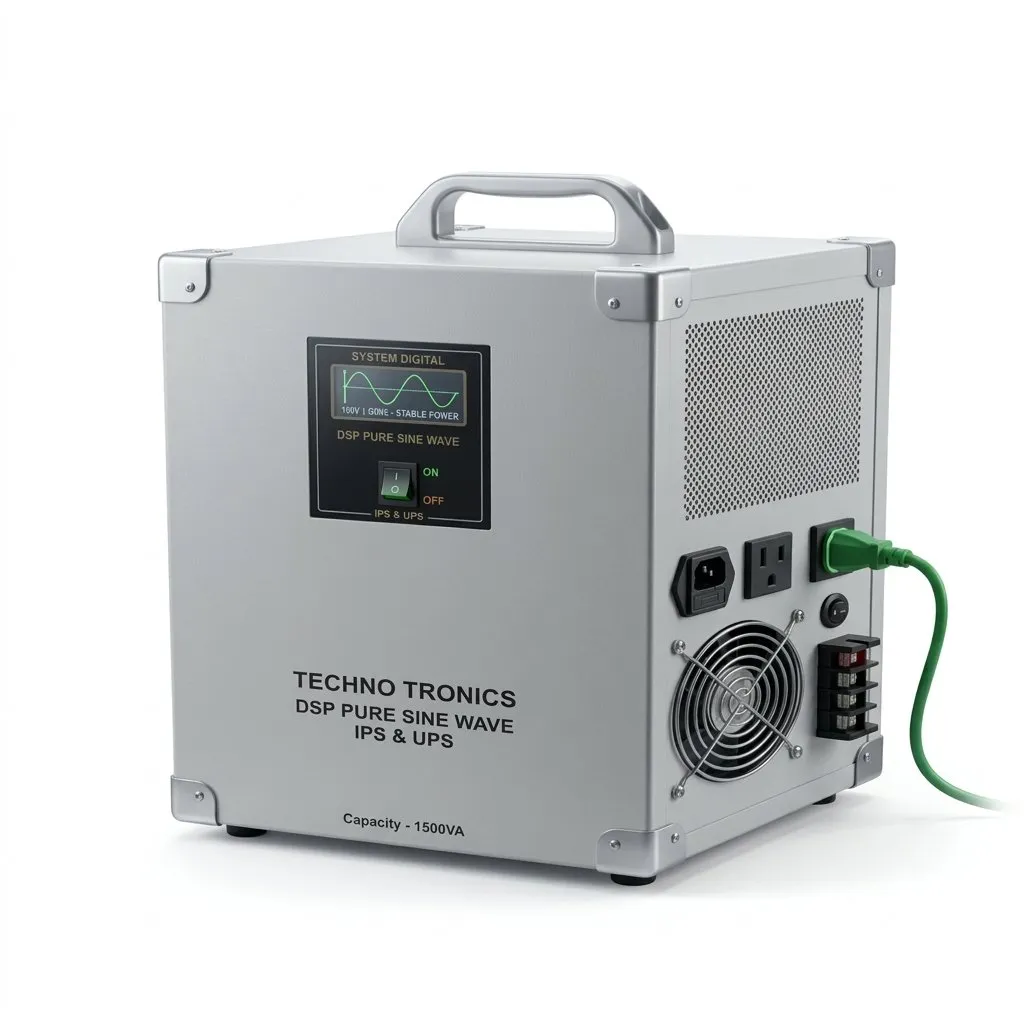
IPS price in Bangladesh: current price list
All the units below are pure sine wave, meaning the output is a smooth wave like the grid supply. That is gentler on ceiling fans, refrigerators, TVs, routers and computer power supplies than the older square-wave boxes, which hum and run motors hot.
| IPS model | Rating | Battery voltage | Typical use | Price (IPS only) |
|---|---|---|---|---|
| Pure Sine Wave IPS 600VA | 600VA | 12V | 2 fans, 4 lights, router | ৳৯,৯০০ |
| Pure Sine Wave IPS 800VA | 800VA | 12V | 3 fans, 5 lights, TV | ৳১১,০০০ |
| Pure Sine Wave IPS 1000VA | 1000VA | 12V | 2-bedroom flat basics | ৳১২,১০০ |
| Pure Sine Wave IPS 1200VA | 1200VA | 12V | 2-bedroom flat with TV and desktop | ৳১৪,৩০০ |
| Pure Sine Wave IPS 1.5kVA | 1.5kVA | 24V | 3-bedroom flat, small shop | ৳১৭,৬০০ |
| Pure Sine Wave IPS 2000VA | 2000VA | 24V | Larger flat, small office | ৳১৯,৮০০ |
| Pure Sine Wave IPS 3kVA | 3kVA | 24V | Duplex, office with several PCs | ৳২৬,৪০০ |
| Pure Sine Wave IPS 4kVA | 4kVA | 48V | Office, clinic, showroom | ৳৪৪,০০০ |
| Pure Sine Wave IPS 5kVA | 5kVA | 48V | Large office or small factory floor | ৳৪৯,৫০০ |
The “typical use” column is a starting point, not a promise. Two flats with the same number of rooms can have very different loads, so read the sizing section before you choose. You can see every model with photos and specifications on our home IPS page.
Why IPS prices differ between shops
When you compare IPS prices online, you will see quotes that look much lower than others. In our experience the gap usually comes from one of four things:
- Square wave vs pure sine wave. Cheap boxes are often modified square wave. They cost less but make fans hum and can shorten the life of motors and chargers.
- Price with or without battery. Some sellers quote a “complete IPS” including one small battery; others quote the box alone. Always ask.
- Real rating vs label rating. A unit labelled 1000VA that cannot actually deliver its rated load is not a bargain.
- Warranty and service. A price that includes installation, a written warranty and someone who answers the phone later is worth more than a lower number with none of that.
What an IPS is and how it works
IPS stands for Instant Power Supply. It is the backup box that has kept lights and fans running in Bangladeshi homes through years of load-shedding. Inside are three parts: a charger, an inverter and an automatic changeover switch.
- When grid power is on, the charger keeps the battery full and your appliances run directly from the mains.
- When the grid fails, the changeover switches your load to the inverter within a fraction of a second.
- The inverter turns the battery’s direct current (DC) into the alternating current (AC) your appliances use, until the grid returns or the battery runs low.
An IPS is not the same as the UPS behind a desktop computer. A small computer UPS is built to keep one PC alive for a few minutes so you can save your work. An IPS is built to run a household or office load for hours. If you want the background, the Wikipedia article on uninterruptible power supplies explains the family of devices both belong to.
What size IPS do you need?
IPS units are rated in VA (volt-amperes). Your appliances are rated in watts. The two are not the same number. For mixed household loads with fans, lights and electronics, a safe rule is that an IPS can comfortably run about 70 percent of its VA rating in watts. So a 1000VA IPS is happiest with a load of about 700 watts.
Step 1: list what must run during load-shedding
Do not list everything in the house. List only what you actually want to keep on when the power goes. Use the wattage on the appliance label, or these typical figures:
| Appliance | Typical watts |
|---|---|
| Ceiling fan (standard) | 70–80 W |
| Ceiling fan (BLDC energy-saving) | 30–35 W |
| LED bulb or tube | 9–20 W |
| Wi-Fi router and ONU | 15–25 W |
| LED TV (32 to 43 inch) | 50–90 W |
| Desktop computer with monitor | 150–250 W |
| Laptop charger | 45–90 W |
| Refrigerator (running) | 120–200 W |
| Water pump (0.5 HP) | about 375 W, with a high start-up surge |
Step 2: add up the watts and divide by 0.7
Here is a typical example for a two-bedroom flat:
- 4 standard ceiling fans: 4 × 75 W = 300 W
- 6 LED lights: 6 × 12 W = 72 W
- Router and ONU: 20 W
- 32-inch LED TV: 60 W
- Refrigerator: 150 W
Total: about 600 W. Divide by 0.7 and you get roughly 860VA. The 1000VA model is the right fit, and it leaves a little room for a laptop charger. If a desktop computer were added, we would step up to 1200VA.
Step 3: check for surge loads
Motors take two to three times their running power for a moment when they start. A refrigerator compressor and a water pump are the usual culprits. If either will run on the IPS, size up one step, and ask us before connecting a pump at all, because many home IPS units are not meant to start one.
What an IPS should not run: air conditioners, electric irons, rice cookers, water heaters and microwave ovens. These use 1,000 to 2,000 watts each and would drain a normal IPS battery in minutes. If you need to run an AC during outages, you are into solar hybrid territory, covered further down.
Choosing the battery: lead-acid or lithium
The battery decides how long your backup lasts and how often you will be buying replacements. Your IPS’s battery voltage is fixed by the model: 12V for 600VA to 1200VA, 24V for 1.5kVA to 3kVA, and 48V for 4kVA and 5kVA in our range. A 24V system needs two 12V batteries in series; a 48V system needs four.
Tubular lead-acid batteries
This is what most Bangladeshi homes still use. Tubular batteries are cheap to buy, widely available and easy to replace. The trade-offs: they are heavy, they need the water level checked, and you should only use about half of the rated capacity if you want them to last. Expect three to four years of life with good care, less in a hot room with deep daily discharges.
LiFePO4 lithium batteries
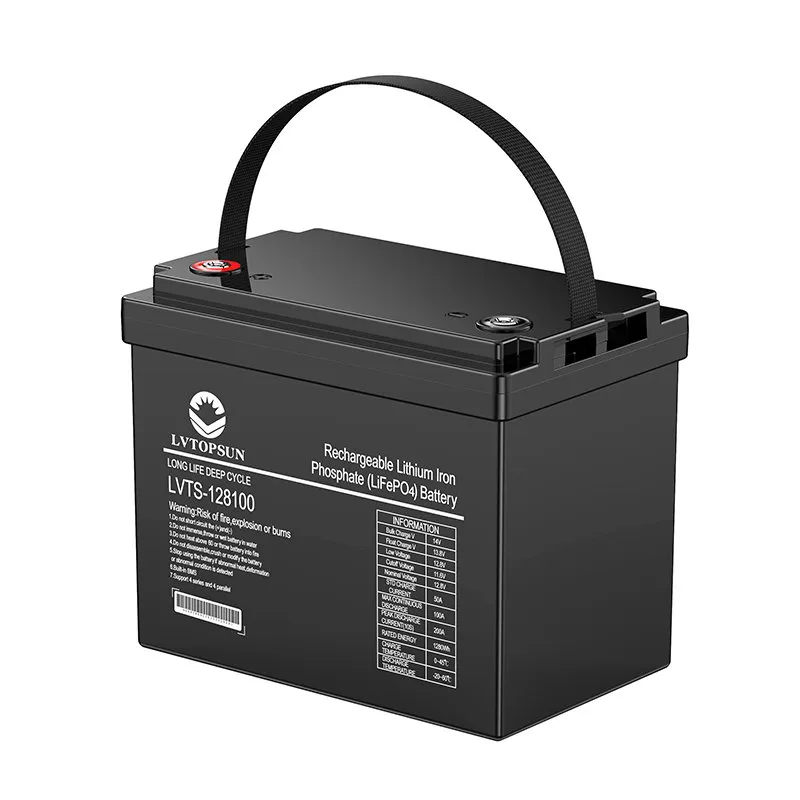
Lithium iron phosphate batteries cost more upfront but you can safely use 80 to 90 percent of their capacity, they need no water, they charge faster and they typically last many more charge cycles. Our 12.8V 100Ah lithium battery is ৳২৪,২০০ and the 24V (25.6V) 100Ah LiFePO4 battery is ৳৪৬,২০০.
Before you pair lithium with an IPS, confirm the IPS charger can be set to a lithium charging profile. Many older units only know lead-acid voltages, which can undercharge or stress a lithium pack. Our full comparison of LiFePO4 vs lead-acid batteries for IPS and solar goes through the numbers in detail.
How long will your IPS run during load-shedding?
Backup time depends on the battery, not the IPS. Here is the simple calculation we use:
Backup hours = battery voltage × battery Ah × usable share × 0.85 ÷ load in watts
The 0.85 covers losses in the inverter. The usable share is about 0.5 for lead-acid if you want long battery life, and about 0.85 for LiFePO4.
Worked examples
| Setup | Load | Approximate backup |
|---|---|---|
| 12V 150Ah tubular lead-acid | 300 W (fans and lights) | 12 × 150 × 0.5 × 0.85 ÷ 300 ≈ 2.5 hours |
| 12V 100Ah LiFePO4 | 300 W | 12.8 × 100 × 0.85 × 0.85 ÷ 300 ≈ 3 hours |
| 24V (two 12V 150Ah lead-acid) | 600 W | 24 × 150 × 0.5 × 0.85 ÷ 600 ≈ 2.5 hours |
| 24V 100Ah LiFePO4 | 600 W | 25.6 × 100 × 0.85 × 0.85 ÷ 600 ≈ 3 hours |
Notice that a 100Ah lithium battery gives a little more usable backup than a 150Ah lead-acid one, because you can use more of it. If your area has two long outages a day, charging speed matters too: a lead-acid battery that has not fully recharged between outages gives less backup the second time. Lithium recovers faster. For longer outages or bigger loads, our guide on how to size a battery for your backup hours shows how to work backwards from the hours you need.
The real cost of an IPS system
When you budget, count the whole system, not just the box:
- The IPS unit, from the price table above.
- The battery or batteries. For lead-acid, ask the current market price of a reputable tubular brand in the capacity you need. For lithium, use the prices above.
- Battery stand or trolley, especially for 24V and 48V banks.
- Wiring and changeover. A separate IPS line to selected fans and lights is the clean way to do it. Old houses sometimes need a small rewiring job.
- Installation. Ask whether it is included.
Then think over five years, not one. A lead-acid battery bank will usually need replacing once in that period; a good LiFePO4 battery usually will not. That is why the lithium option often costs about the same or less over the life of the system, even though the first payment is higher.
IPS or solar hybrid inverter?
An IPS only stores grid electricity. It never lowers your bill; in fact charging the battery uses a little extra power. A solar hybrid inverter does everything an IPS does, and also takes power from solar panels on your roof, so on sunny days it runs your home from sunshine and recharges the battery for free.
An IPS is still the sensible choice if:
- You rent and cannot put panels on the roof.
- You only need fans, lights and the router for an hour or two at a time.
- Your budget is under about ৳30,000 for the whole system.
A hybrid is worth a look if you own the roof, have a monthly bill above roughly ৳3,000, face long outages, or want to run heavier loads. A Growatt 3.5kW hybrid inverter is ৳৬৪,৯০০, and an off-grid hybrid such as the Growatt 3500VA off-grid inverter is ৳৩৮,৫০০. We wrote a full comparison of IPS vs solar hybrid inverter for load-shedding with real numbers for a flat and a shop.
IPS buying checklist
Before you pay, check these points. Shopkeepers who know their products will answer all of them without hesitation.
- Is the output pure sine wave? Ask to see it written on the box or datasheet.
- What is the real continuous rating in watts, not just the VA on the label?
- What battery voltage does it need, and does the price include any battery?
- Does the charger have a lithium setting if you plan to use LiFePO4?
- What protections are built in: overload, short circuit, low battery cut-off and over-temperature?
- How long is the warranty, what does it cover, and where do you take the unit for service?
- Does the unit have a display showing battery level and load? It helps you manage outages.
- Is installation included, and will the installer wire a separate IPS line?
Seven common mistakes we see
- Buying by room count instead of load. A two-bedroom flat with a fridge and a desktop needs more than a two-bedroom flat without them.
- Connecting the whole house. If every socket is on the IPS, someone will plug in an iron or a rice cooker during an outage and trip it. Wire only the circuits you need.
- Undersizing the battery. A big IPS on a small battery gives a short backup and kills the battery early.
- Mixing old and new batteries. In a 24V or 48V bank, one weak battery drags the others down. Replace them as a set.
- Putting the battery in a hot, closed space. Heat shortens battery life sharply. A cool, ventilated corner is best.
- Ignoring water levels. Tubular batteries that run dry fail fast. Check monthly.
- Choosing the cheapest square-wave box. The savings disappear the first time a fan motor or fridge compressor fails early.
Care, safety and maintenance
An IPS is a simple machine and lasts many years with basic care:
- Keep the unit and battery off the floor, away from water, and with space around them for air to flow.
- Dust the vents every few months. A clogged fan makes the IPS run hot.
- For lead-acid batteries, top up with distilled water only, never tap water, and keep terminals clean and tight.
- Let the battery go through a normal discharge now and then if you rarely have outages; batteries that sit fully charged for months can lose capacity.
- Never open the IPS yourself. It stores energy even when switched off. Call a technician.
- Use proper battery cables and lugs. Thin wires and loose connections cause heat and, in the worst case, fire.
Frequently asked questions
What is the price of a 1000VA IPS in Bangladesh?
Our pure sine wave 1000VA IPS is ৳১২,১০০ without battery. Add the price of one 12V battery. A 12.8V 100Ah lithium battery is ৳২৪,২০০; a tubular lead-acid battery costs less upfront but needs replacing sooner.
Which IPS is best for a two-bedroom flat?
For fans, lights, a router, a TV and a fridge, a 1000VA or 1200VA pure sine wave unit fits most two-bedroom flats. Add up your actual load as shown in the sizing section and divide by 0.7 to confirm.
Can an IPS run an air conditioner?
Not a normal home IPS. An AC draws 1,000 to 2,000 watts and would drain the battery in minutes. If you want AC during load-shedding, look at a solar hybrid inverter with a large lithium battery.
How long does an IPS battery last?
A tubular lead-acid battery usually lasts three to four years with good care. A LiFePO4 lithium battery usually lasts much longer, often several thousand charge cycles, which for most homes means many years.
Can I use a lithium battery with my old IPS?
Only if the IPS charger can be set to a lithium charging profile and the battery voltage matches. Otherwise the battery may never charge fully. Send us the IPS model and we will tell you whether it is compatible.
Does an IPS increase my electricity bill?
Slightly. Charging the battery and the IPS’s own standby use add a small amount to the bill. A solar hybrid inverter is the option that lowers your bill instead.
Is a pure sine wave IPS really necessary?
For modern homes, yes. Fans run quieter and cooler, fridges and routers are happier, and electronics last longer. The price difference is small compared with the cost of a damaged appliance.
Do you deliver and install IPS outside Dhaka?
We deliver across Bangladesh to district and upazila delivery points. Call us on +880 1712-567878 to discuss installation options in your area.
Getting the right IPS: your next step
The right IPS is the one sized to your real load, paired with a battery that gives the backup hours you need. Write down what you want running during outages, add up the watts, divide by 0.7, and pick the model from the table above. If you would rather have a second opinion, send us your list on WhatsApp or call +880 1712-567878 and we will suggest the IPS and battery combination that fits your home and budget.
সচরাচর জিজ্ঞাসা
What is the price of a 1000VA IPS in Bangladesh?
Our pure sine wave 1000VA IPS is ৳11,000 without battery. Add the price of one 12V battery. A 12.8V 100Ah lithium battery is ৳22,000; a tubular lead-acid battery costs less upfront but needs replacing sooner.
Which IPS is best for a two-bedroom flat?
For fans, lights, a router, a TV and a fridge, a 1000VA or 1200VA pure sine wave unit fits most two-bedroom flats. Add up your actual load as shown in the sizing section and divide by 0.7 to confirm.
Can an IPS run an air conditioner?
Not a normal home IPS. An AC draws 1,000 to 2,000 watts and would drain the battery in minutes. If you want AC during load-shedding, look at a solar hybrid inverter with a large lithium battery.
How long does an IPS battery last?
A tubular lead-acid battery usually lasts three to four years with good care. A LiFePO4 lithium battery usually lasts much longer, often several thousand charge cycles, which for most homes means many years.
Can I use a lithium battery with my old IPS?
Only if the IPS charger can be set to a lithium charging profile and the battery voltage matches. Otherwise the battery may never charge fully. Send us the IPS model and we will tell you whether it is compatible.
Does an IPS increase my electricity bill?
Slightly. Charging the battery and the IPS's own standby use add a small amount to the bill. A solar hybrid inverter is the option that lowers your bill instead.
Is a pure sine wave IPS really necessary?
For modern homes, yes. Fans run quieter and cooler, fridges and routers are happier, and electronics last longer. The price difference is small compared with the cost of a damaged appliance.
Do you deliver and install IPS outside Dhaka?
We deliver across Bangladesh to district and upazila delivery points. Call us on +880 1712-567878 to discuss installation options in your area.
সংশ্লিষ্ট পণ্য
-
জেটাটেক
হেভি-ডিউটি ই-রিকশা লিথিয়াম পাওয়ার প্যাক ৪৮ ভোল্ট ১০০ অ্যাম্পিয়ার আওয়ার (৪.৮ কিলোওয়াট আওয়ার)
৳৮৫,৮০০ স্টকে আছে -
পিউর সাইন ওয়েভ আইপিএস ৫ কেভিএ (৪৮ ভোল্ট)
৳৪৯,৫০০ স্টকে আছে -
পিউর সাইন ওয়েভ আইপিএস ৪ কেভিএ (৪৮ ভোল্ট)
৳৪৪,০০০ স্টকে আছে -
পিউর সাইন ওয়েভ আইপিএস ৩ কেভিএ (২৪ ভোল্ট)
৳২৬,৪০০ স্টকে আছে