Quick answer
Pick an on-grid inverter if you only want to lower your bill, a hybrid inverter if you also want backup during load-shedding, and an off-grid inverter only when you have no reliable grid connection.
On this page: What a solar inverter actually does · How each of the three types works · On-grid vs hybrid vs off-grid inverter: side-by-side comparison · A five-step framework for the on-grid vs hybrid vs off-grid inverter decision · Worked example: a Dhaka flat with load-shedding · Choosing by situation: home, shop and factory · Cost, payback and upgrading, without the sales pitch · Common mistakes to avoid · Frequently asked questions · Your next step with on-grid vs hybrid vs off-grid inverter choices
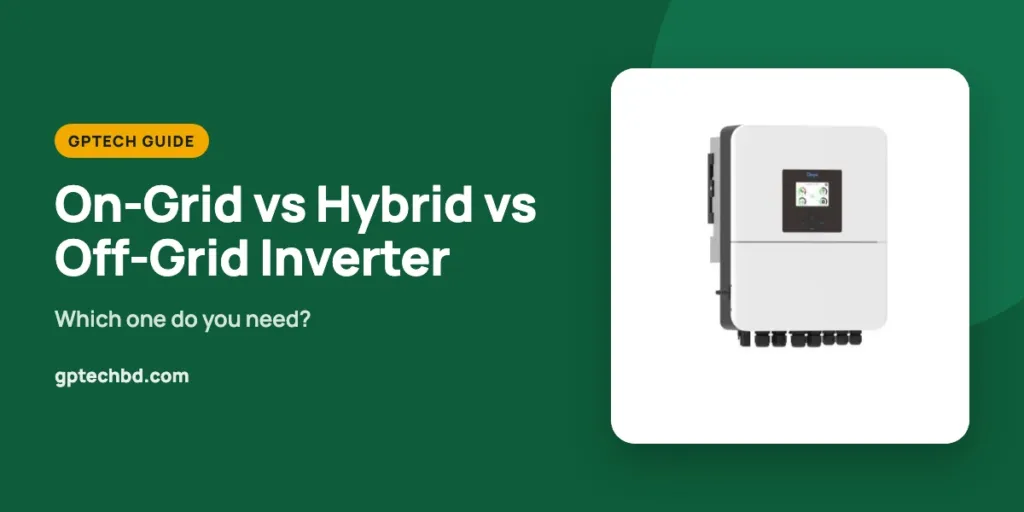
The short answer to the on-grid vs hybrid vs off-grid inverter question is this: choose an on-grid inverter if your power is mostly stable and you only want lower bills, choose a hybrid inverter if you also want backup during load-shedding, and choose an off-grid inverter only when there is no usable grid connection at all. Most Bangladeshi homes and shops that suffer regular outages end up with a hybrid system. Large factories and offices that run mostly in daytime usually do best with on-grid.
The three names sound like jargon, but they describe just one thing: how your solar panels, your batteries and the utility line are allowed to talk to each other. In this guide we explain how each inverter type works, compare them side by side, walk through a simple decision framework, and run a real calculation for a typical home. You will also see the mistakes we most often meet at site surveys, and answers to the questions customers ask us on the phone.
What a solar inverter actually does
Solar panels produce direct current (DC), the kind of electricity a battery stores. Your fans, ACs, fridge and lights run on alternating current (AC). The inverter is the device that converts one into the other, and it also decides where the power goes: to your loads, into a battery, or out to the grid.
Almost every modern solar inverter has one or more MPPT inputs. MPPT stands for maximum power point tracking, which simply means the inverter constantly adjusts the electrical load on the panels so they deliver as much power as the sunlight allows at that moment. This matters in Bangladesh, where passing clouds and monsoon haze change the sunlight every few minutes.
If you want the general technical background, the Wikipedia article on solar inverters is a reasonable neutral reference. For product choices, you can browse our full range of solar inverters once you know which family fits you.
How each of the three types works
To see how on-grid vs hybrid vs off-grid inverter designs differ, picture what happens on the day the grid trips off. Each type reacts differently, and that single moment explains most of the differences below.
On-grid inverter (also called grid-tie)
An on-grid inverter works only while the utility grid is present. It matches the grid voltage and frequency and pushes solar power into your building wiring. Whatever your loads need is taken from solar first, and the shortfall is drawn from the grid. There is no battery.
When the grid goes down, an on-grid inverter switches itself off within moments. This is a safety feature called anti-islanding: it stops your roof from sending power into a line that utility workers believe is dead. The practical result surprises many first-time buyers. During load-shedding, a plain on-grid system gives you nothing, even at noon on a sunny day.
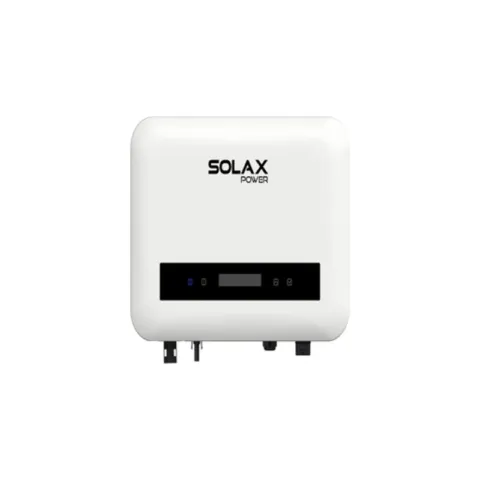
Single-phase models suit homes and small shops, while three-phase models suit factories, large buildings and anything with a three-phase connection. You can see both families under on-grid inverters.
Hybrid inverter
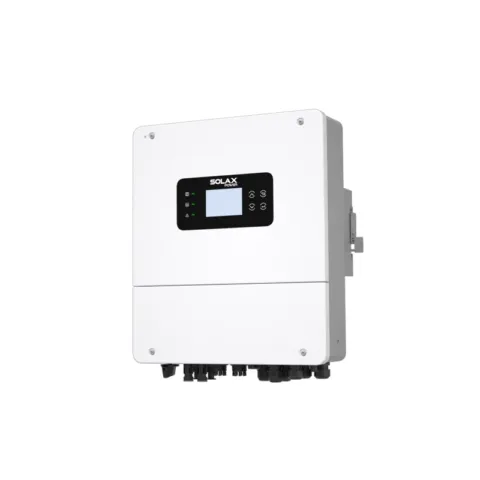
A hybrid inverter does three jobs in one box. It converts solar DC, it charges and discharges a battery, and it connects to the grid. When the grid fails, it disconnects from the line and keeps supplying your essential loads from solar and battery. The change-over is quick enough that most lights and fans barely flicker, though you should still check the stated transfer time for sensitive equipment.
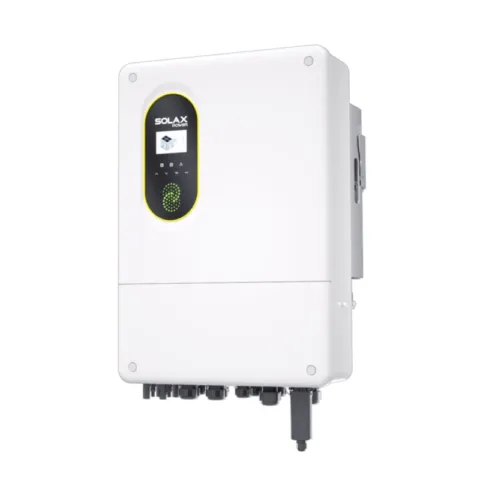
Hybrids can be set to different priorities. You might tell the inverter to use solar first, then battery, then grid. Or you might keep the battery full for outages and use it only when the grid drops. The range of hybrid inverters includes single-phase and three-phase versions, and brands such as Deye are especially popular for home backup.
Off-grid inverter
An off-grid inverter never sends power to the grid and does not depend on it. Panels charge the battery, and the inverter powers your loads from the battery. Some models also accept a diesel generator or a grid input as an emergency charging source, but the design logic is a standalone power station.
This is the right tool for a remote farmhouse, a char area home, a pump station or a telecom-style site where the grid is absent or unreliable for days. If you want to look at those models, see our off-grid inverter range.
On-grid vs hybrid vs off-grid inverter: side-by-side comparison
The table below puts the three sides of the on-grid vs hybrid vs off-grid inverter choice next to each other. Use it as a quick filter before reading the longer decision steps.
| Feature | On-grid | Hybrid | Off-grid |
|---|---|---|---|
| Needs the utility grid | Yes, always | Works with or without | No |
| Battery | Not used | Used (usually lithium) | Essential |
| Works during load-shedding | No | Yes, for the loads you connect | Yes |
| Can export surplus to the grid | Yes, subject to utility approval | Usually yes, if configured | No |
| Upfront complexity | Lowest | Medium | Medium to high |
| Best fit | Daytime-heavy shops, offices, factories | Homes and shops with outages | Places with no grid |
| Main weakness | No backup power | Battery adds cost and needs space | Battery and panels must cover everything |
You can also put specific models next to one another with our product comparison tool when you are down to two or three candidates.
A five-step framework for the on-grid vs hybrid vs off-grid inverter decision
When someone asks us about on-grid vs hybrid vs off-grid inverter choices, we do not start with brands. We ask five questions in a fixed order, and the answer usually becomes obvious by question three.
- Is there a grid connection at the site? If there is no connection and none is planned, the answer is off-grid, and you can skip the rest. If there is a connection, continue.
- How often and how long does the power go? Write down a typical week. If you lose power for a few minutes a month, backup is a luxury. If you lose it for an hour or more most days, backup is the main reason you are buying.
- When do you use electricity? A garment unit or an office that runs from 9 am to 6 pm uses most of its solar output directly. A family that comes home at 6 pm and runs two ACs all night does not.
- What must keep running during an outage? Decide on essentials: lights, fans, router, fridge, perhaps one AC or a water pump. Backup for everything is possible but expensive.
- Do you plan to apply for net metering? This is the arrangement where surplus solar is exported to the utility and credited. Rules vary, so read our guide on net metering in Bangladesh and confirm current requirements with your distribution utility before you buy.
Now read your answers. No grid means off-grid. Stable grid and daytime use points to on-grid. Frequent outages or evening-heavy use points to hybrid. Mixed answers, such as stable power but a wish for future backup, often justify a hybrid inverter installed with a small battery now and more later.
Worked example: a Dhaka flat with load-shedding
Take a family in a rooftop-access building with a daily outage of about three hours in the evening. They want to keep four ceiling fans, six LED lights, a router, a fridge and a television running during that time. The numbers below are typical round figures; your own appliances will differ.
- Four ceiling fans at 75 W each: 4 x 75 = 300 W
- Six LED lights at 10 W each: 6 x 10 = 60 W
- Router and television: roughly 100 W + 100 W = 200 W
- Fridge (average draw while cycling): about 150 W
Total essential load is 300 + 60 + 200 + 150 = 710 W, so we call it 0.71 kW. Over three hours the energy needed is 0.71 x 3 = 2.13 kWh. A kilowatt-hour (kWh) is simply one kilowatt used for one hour, the unit your electricity bill uses.
Next we allow for losses. Inverters are not perfect; assume 92 percent efficiency, so the battery must supply 2.13 / 0.92 = 2.32 kWh. Lithium batteries should not be drained fully every day. If you plan to use no more than 90 percent of the rated capacity (a depth of discharge, or DoD, of 90 percent), the nominal battery size is 2.32 / 0.90 = 2.57 kWh.
That lands very close to a 2.56 kWh lithium battery, so a more comfortable choice would be a 5 kWh unit. That leaves room for a longer outage, a battery that has aged, or an extra appliance. Our separate guide on sizing a battery for your backup hours goes deeper into this method.
For the inverter itself, the maximum simultaneous load matters. If the family also wants to run one 1.5-ton AC during outages, add roughly 1.5 kW, giving about 2.2 kW. A 3 to 5 kW hybrid would cover that with headroom for motor start-up surges. This family clearly needs a hybrid inverter; an on-grid unit would leave them in the dark exactly when they need it. That is the on-grid vs hybrid vs off-grid inverter decision made with arithmetic instead of guesswork.
Choosing by situation: home, shop and factory
The right on-grid vs hybrid vs off-grid inverter answer changes with the building, so here is how we usually think about each type of customer.
Urban home or apartment
Rooftop access is often shared and space is tight, so the goal is usually backup plus lower bills. A hybrid inverter with a modest lithium battery covers both. If your building already has a generator for common areas and your own outages are rare, on-grid alone can be enough. Our guide comparing IPS and solar hybrid inverters for load-shedding will help if you are replacing an old backup unit.
Shops and small businesses
A shop that opens at 10 am and closes at 9 pm uses solar directly for much of its day. Refrigerated display cases, lights and billing computers are the loads that must not stop. Many shop owners pick a hybrid inverter and connect only these essentials to the battery side, while heavy loads such as an AC stay on the main supply. Compare that to the cost and noise of running a diesel generator for the same outage hours.
Factories and large commercial buildings
Here, loads are large, the sanctioned supply is three-phase, and daytime use is high. Battery backup for the whole plant is rarely economical, because a diesel generator already exists for outages. A three-phase on-grid inverter lowers the daytime grid bill without extra storage. We cover the engineering side in rooftop solar for factories.
Farms, pumps and remote sites
Where the grid is far away or very unreliable, an off-grid setup is the honest answer. Size the panels and battery for your worst week, not your best, and consider a generator as a rare backup. Monsoon cloud can cut solar output for days, so allow for it.
Cost, payback and upgrading, without the sales pitch
We are not quoting prices in this article, because they change with exchange rates and duty. What we can give you is the way to think about them. In the on-grid vs hybrid vs off-grid inverter comparison, the gap in cost comes mostly from the battery. An on-grid system costs the least per kilowatt because it has no battery. A hybrid adds the battery and a more complex inverter. An off-grid system also needs a battery, usually larger, because it must carry the full load.
The payback logic differs too. An on-grid system pays back through lower electricity bills only. A hybrid pays back through lower bills plus avoided costs: less diesel, less frequent IPS battery replacement, and fewer losses from outages in a business. An off-grid system is often not compared with the grid at all; its alternative is a diesel generator or no electricity.
A simple way to compare is to add up what outages cost you now. A shop that loses sales or spoils stock during a three-hour blackout may find that backup is worth more than the bill savings. A family that rarely loses power may find on-grid pays back faster. For realistic budget ranges, see our solar system price guide and then ask for a quotation.
The battery question
If you choose hybrid or off-grid, the battery type matters as much as the inverter. Lithium iron phosphate (LiFePO4) batteries give more usable capacity, last for many more cycles and need less maintenance than lead-acid. We compare them in detail in lithium vs lead-acid for IPS and solar, and you can view the available lithium batteries directly.
Starting small and upgrading later
Whichever on-grid vs hybrid vs off-grid inverter you lean toward, think about year three as well as day one. Many customers cannot afford the full system on day one. The question then is which choice keeps the door open. Buying an on-grid inverter today and wanting backup next year usually means replacing the inverter, because a plain grid-tie unit cannot manage a battery.
Buying a hybrid inverter today and adding the battery later is far smoother. You can start with solar and the grid, then connect a battery when your budget allows. Check that the inverter supports the battery you want, including the communication cable, and that the maximum battery current suits the size you may add later.
Also think about panel growth. Ask how many MPPT inputs the inverter has, what its maximum DC input is, and whether adding panels later would exceed it. A good installer will draw this on paper for you during the site survey.
Common mistakes to avoid
Nearly every complaint we hear about the on-grid vs hybrid vs off-grid inverter choice comes from one of the seven slips below.
- Buying on-grid and expecting backup. This is the most frequent complaint we hear. If a salesperson did not mention that the system shuts down in an outage, ask again before paying.
- Buying a hybrid but connecting the entire building to the backup side. The inverter and battery were sized for essentials. Connecting a water heater, geyser or several ACs will overload it. Use a separate backup distribution board for essentials.
- Undersizing the battery. A battery sized for exactly your calculated need leaves no margin for aging, hot rooms or an extra load. Add a sensible buffer.
- Ignoring the phase. A three-phase connection needs a three-phase inverter, or at least careful design. A single-phase unit on a three-phase building can unbalance the supply.
- Choosing by brand name alone. The same brand sells several grades. Read the datasheet for MPPT voltage range, surge rating, and battery compatibility. Our Deye vs Growatt vs Huawei comparison shows what to check.
- Skipping the warranty details. Know what is covered, who services it in Bangladesh and how long a replacement takes. Read what an inverter warranty does and does not cover.
- Forgetting dust, heat and humidity. Install the inverter in a shaded, ventilated spot, not a closed hot cupboard on a sun-baked wall.
Frequently asked questions
Can an on-grid inverter work without electricity from the grid?
No. A standard on-grid inverter needs the grid signal to operate and switches off when the grid fails. This is a safety rule for line workers. If you want power during load-shedding, you need a hybrid or off-grid system.
Is a hybrid inverter always better in the on-grid vs hybrid vs off-grid inverter debate?
Not always. A hybrid adds capability, but you only benefit if you use it. For a factory with a generator and stable supply, an on-grid inverter delivers the savings at lower cost and complexity.
Can I add a battery to my existing on-grid system later?
Sometimes, through AC-coupled battery inverters, but it is usually neater to start with a hybrid inverter. Ask an engineer to inspect your existing system before deciding, because compatibility depends on the model.
What is the difference between an off-grid inverter and a hybrid inverter?
An off-grid inverter is designed to stand alone and has little or no ability to export power to the utility. A hybrid inverter works with the grid, with a battery, or with both, and can usually feed surplus into the grid where that is permitted.
Will a hybrid inverter run my AC during load-shedding?
It can, if the inverter’s output rating, the battery’s discharge rate and the battery size all suit the AC. A 1.5-ton split AC can draw roughly 1.5 kW or more while running, plus a start-up surge. Running it for several hours needs a bigger battery than lights and fans do.
In an on-grid vs hybrid vs off-grid inverter comparison, which is cheapest?
Generally on-grid costs least for the same solar capacity because there is no battery. Hybrid and off-grid cost more because of storage. Cost is only half the story; compare what each option saves or avoids over its lifetime.
Do I need permission to install a grid-connected inverter?
If you connect to the utility, especially to export power, you generally need the distribution utility’s approval. Requirements and limits change, so confirm with DESCO, DPDC, BREB, NESCO, WZPDCL or your local office before purchase.
How long do solar inverters last?
Many quality inverters are designed to last around ten years or more with proper ventilation and clean power, but the warranty period varies by brand and model. Ask for the written warranty terms before you buy.
Your next step with on-grid vs hybrid vs off-grid inverter choices
If you have read this far, you already know more than most buyers. Write down your outage hours, your essential loads and your daytime use, and the answer to the on-grid vs hybrid vs off-grid inverter question will usually be clear.
If you would like a second opinion, call GPTECH on +880 1712-567878 or message us on WhatsApp for a free site survey and quotation. We supply genuine, warranty-backed products with delivery across Bangladesh, and you can read our shipping and delivery details or contact us online. There is no pressure; a good system is one you understand before you buy.
Frequently asked questions
Can an on-grid inverter work during load-shedding?
No. An on-grid inverter shuts down when the grid goes off, for safety, so it does not give you backup. Choose a hybrid inverter with a battery if you want backup.
Do I need a battery with a hybrid inverter?
Not at the start. A hybrid inverter can run without a battery and a battery can be added later, but the battery is what keeps your loads running during load-shedding.
Which type of inverter is the cheapest?
An on-grid inverter is the cheapest option per kW because it has no battery.
Should I choose a single phase or three phase inverter?
Match the inverter to your electricity connection. Most homes use single phase; factories, large offices and some big homes use three phase.
Related products
-
SolaX
SolaX 5kW Single Phase On-Grid Solar Inverter (X1-MINI-5K-G4-P)
৳33,000 In stock -
SolaX
SolaX 3kW Single Phase Low Voltage Hybrid Solar Inverter
৳100,100 In stock -
SolaX
SolaX 5kW Single Phase Low Voltage Hybrid Solar Inverter (SREDA approved)
৳121,000 In stock -
SolaX
SolaX 10kW Three Phase Low Voltage Hybrid Solar Inverter
৳242,000 In stock